Efficacy Product Overview
Scientists proved the effectiveness of Far-UV. Aeraze controls its irradiation based on evidence, rapidly and automatically.
Clearing high-touch surfaces and indoor high-traffic environments from pathogens has become a global priority to prevent outbreaks. UV Germicidal Irradiation (UVGI) is a proven technology.
The disinfection using UV-irradiation is an extensively tested, widely used, and effectively recognised environmentally friendly method of inactivating both drug-sensitive and multi-drug-resistant bacteria, as well as differing strains of viruses without the use of harmful chemicals or heat.
UV-C (100–280 nm) is most employed in germicidal applications. Over the UVC range, a more detrimental effect on microbial cells occurs because the intercellular components of microbes (e.g., RNA, DNA, and proteins) can sensitively absorb UVC photons. Absorbed UVC photons cause critical damage to the genomic system of microorganisms (nucleic acid and microorganismal proteins), preventing them from replicating and surviving, where the adenine–thymine bond is collapsed and a covalent linkage, pyrimidine dimer, is generated between two adenines leading to inability of the cell to replicate. Therefore, the effect of UV irradiation on microorganisms is called “inactivation” and not “killing”.
Far-UVC light (207 to 222 nm) has been shown to be as efficient as conventional germicidal UVC light in killing microorganisms, but studies to date suggest that these wavelengths do not cause the human health issues associated with direct exposure to conventional germicidal UVC light. In short, the reason is that Far-UVC light has a penetration range in biological materials of less than a few micrometres, and thus it cannot reach living human cells in the skin or eyes, being absorbed in the skin stratum corneum or the ocular tear layer. Although 222nm wavelength is considered less harmful than conventional UVC we recommend following safety recommendations based on ICNIRP guidelines. As Aeraze is intended for professional operators use only, operator’s skin and eyes must be properly protected by personal protective equipment. Aeraze’s APP control features an exposure limit for the operator stopping irradiation at the set value as a further safety measure.
Aeraze was designed to effectively clear high-traffic areas ensuring efficacy and minimizing exposure of people and materials, preventing all issues relating to human health and aging of materials. Aeraze achieves inactivation of the desired pathogens by combining a high-power source in a handpiece to an automatic control system that integrates a sensor suite.
Efficacy Product Data
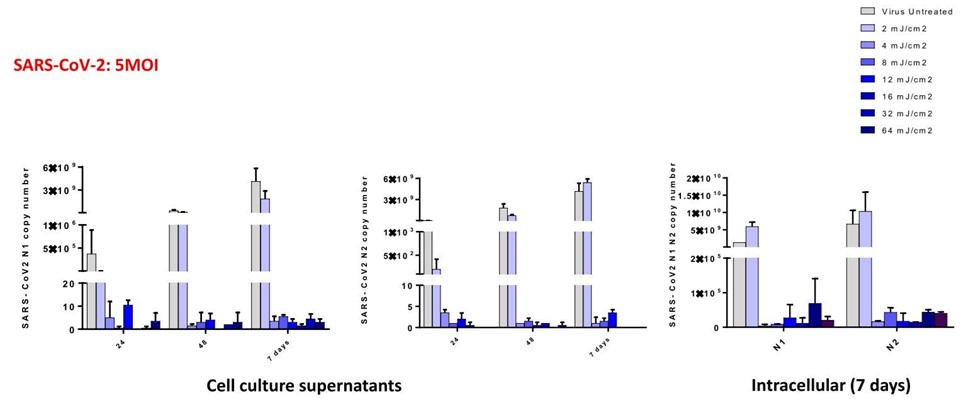
The Dynamic Dosage Control irradiation dosage has been proved with trials on real SARS-COV-2 virus and is confirmed by academic research
Aeraze’s irradiation dosage is in accordance with the trials performed on actual 5MOI SARS-COV-2 samples with the Aeraze excimer source in the Virology Laboratory of Dipartimento di Scienze Biomediche e Cliniche L. Sacco of the University of Milan, to achieve complete inactivation (on top of 3logs). These tests have been performed according to:
Biasin, M., Bianco, A., Pareschi, G. et al. UV-C irradiation is highly effective in inactivating SARS-CoV-2 replication. Sci Rep 11, 6260 (2021).
https://doi.org/10.1038/s41598-021-85425-w
The design of Aeraze’s handpiece and the operation of the reflector do increase the actual irradiation by a minimum of 30% due to overexposure on top of its Dynamic Dosage System indication. We consider this increase as added safety for the effectiveness of Aeraze’s operation.
The referenced trials have been performed on a joint programme of INAF and the Dipartimento di Scienze Biomediche e Cliniche L. Sacco of Milan, assisted by IST (Istituto Nazionale dei Tumori) of Milan. The outcome shown in the graphic below, corrected by absorption factors specifically for the 222nm wavelength is that “over 4mJ/cm² the virus is completely inactivated”